Four core engineering principles that unite portability and performance.
The Foldingantennas Folding Beam builds on the Broadband Hexbeam refined by Steve Hunt (G3TXQ) – one of the most popular designs for lightweight multiband directional antennas in amateur radio. The design eliminates traps and coils entirely, achieving broadband behaviour across all five bands through the specific geometry of the wire elements.
Foldingantennas evolved this proven concept: the spreaders lie in a flat plane rather than curving upwards, eliminating bending stress and enabling thinner, lighter fibreglass profiles – while simultaneously forming the foundation for the folding mechanism.
Each of the six fibreglass spreaders consists of three hinged sections connected via self-locking joints. When folding, all spreaders collapse inward simultaneously – wire elements, support cords, and all connection points remain permanently mounted. There is no need to disassemble the antenna at any point.
The central aluminium centre tube serves simultaneously as mechanical support and coaxial conductor. The inner conductor runs through the tube directly to the feed point – an elegant solution that eliminates external cable routing and makes the antenna robust during transport.
By arranging the spreaders in a flat plane (rather than the upward curve of a classic hexbeam), bending stresses are eliminated entirely. This allows thinner, lighter fibreglass profiles without compromising rigidity. Result: total weight approx. 6 kg with a turning radius of only 3.20 m.
Each of the five bands (20, 17, 15, 12, 10 m) uses its own driver/reflector pair, arranged concentrically on the spreaders. The specific wire geometry achieves SWR < 2:1 across all bands – without traps, coils, or tuning.
All structural metal components are aluminium or stainless steel. Clamps and hinges are made from high-temperature PBT plastic. The fibreglass spreaders are UV-stabilised. This combination ensures durability under repeated assembly/disassembly and in changing weather conditions.
With approx. 5 dBi free-space gain and a front-to-back ratio of more than 20 dB, the Folding Beam delivers a measurably better result than wire antennas. The directional effect is especially noticeable in pile-ups or when QRM arrives from a specific direction.
Measured SWR values on a representative unit. Typical values < 2:1 across the entire band.

14.0–14.35 MHz
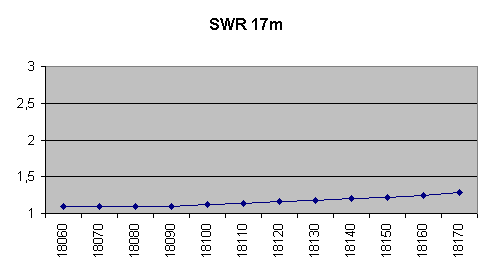
18.068–18.168 MHz
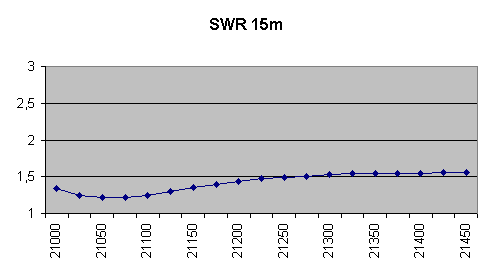
21.0–21.45 MHz

24.89–24.99 MHz
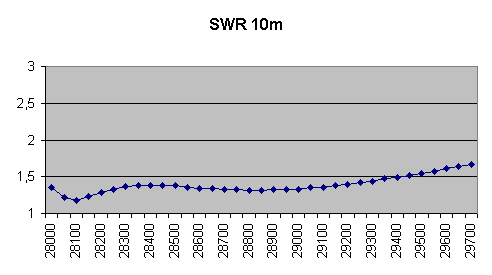
28.0–29.7 MHz
Available at the WiMo shop – with expert advice and fast shipping.
Buy at WiMo Technical specs DE
DE EN
EN